Follow my blog on Bloglovin

Friday, June 19, 2015

Southern Gothic

Under Magnolia, A Southern Memoir, was a great surprise. I wasn't sure if I'd enjoy reading yet another novel about growing up in the South. But Frances Mayes (known for her Tuscany books) used poetic images and elegant prose to describe growing up in Georgia in the fifties. Passages like this one "…Listening to women - playing bridge, shelling peas, visiting the dressmaker - those who were dead seemed present…" - evoked the women of my own childhood in Mississippi in the sixties. But like all Southern families I know, this  story was not without its damaged characters and twists in the plot line.   Her parents, unhappy with each other and small town life, drank and fought in the background and sometimes foreground of her childhood.  Her father died while she was in high school and her feelings about him were even more complicated after his passing.  His death left her alone in the house with her mother throughout her difficult teen years and their relationship was fraught with emotion. But her tribute to her mother later in the book is one of the most beautiful I've ever read.
Mayes' mother, Frankye 

"She will never lean toward the light, moisten the thread between her lips, and thread the needle. She'll never throw one sheet on the floor and pile on the dirty laundry. Brush her hair a hundred strokes….no more - placing blue hydrangeas in a glass bowl, scraping her rings on the inside of the black mailbox, boiling jars for peach pickles, dabbing a bath powder puff under her arms, refusing catfish because they're bottom feeders, bidding grand slams, pulling meat off the bone for chicken divan, hand washing a peach silk slip, surrounding the birthday cake with pink camellias…" This describes my mother and probably some of your mothers as well, if you grew up in the South. 


Mayes never directly says why she has never written about her family of origin and her place of origin. Her beloved Tuscan books certainly evoke a strong sense of place and identification of the culture of that place. Yet, I, for one never knew about her Southern upbringing.  Once Mayes moved to California with her first husband in her early twenties, she never looked back on her past.  California is a place of re-invention and Mayes did just that.  She says, "When I left the South at age twenty-two, the force that pushed me west was a powerful as the magnet that held me."  She went on to later buy the home in Tuscany and began to write her many books about Tuscany. Her genre is memoir and essay, so this book at age 75 is a long-awaited remembrance for her fans.  She did write a novel, set in Georgia, called Swan, published in 2002, but I think this memoir is Mayes at her finest with strong imagery and boldly accurate descriptions of small town Southern life.


In the preface, Mayes shares what made her decide to write a book about her childhood. She was in Oxford, Mississippi, one of my favorite places, for a reading at Square Books, one of my favorite bookstores, and the feeling of being in a small town in the South brought back memories she had avoided for years. In fact, she said, "For years when I went back home to visit, I broke out in hives." As she wanders through Oxford and even visits Faulkner's house, the smells and sounds of the South that she had ignoring for years drew Mayes back in. She had long known the resemblances of Tuscany and the South - "the complex interconnections of family and friends, the real caring for one another, the incessant talk, emphasis on ancestors, the raucous humor, the appreciation of the bizarre, the storytelling, the fatalism, the visiting, the grand occasions…"  Now she realized that she wanted to go back to the South, to re-look at her past and to even live in the South. At the end of that visit to Oxford, Mayes called her husband and told him, "I want to move back South."  They did indeed move to rural North Carolina and Mayes wrote this lovely memoir about the South. Thank you Oxford and Square Books!  I was pleased to receive this book from Blogging for Books for this review.

Monday, May 25, 2015

The Past Binds to the Present


The World Before Us by Aislinn Hunter is a haunting book about memory and uncovering the past.  I feel it was a literary fiction “sleeper” because I had not heard of it through any of my usual book sources. I selected it through my affiliation with Blogging for Books. I was entranced by this novel and read the last three-quarters this past rainy Saturday afternoon. This book combined a historical mystery with a modern tragedy. The plot felt a bit thin at times, but it propelled me along enough to stay interested. 

An archivist in a small London museum, Jane Standen, becomes interested in a Victorian asylum and an old estate separated by woods she had wandered in as a teenager.  For the second half of the book, she is re-visiting this spot outside of London as her past and her present come together. The Victorian era mystery is linked to the modern tragedy through a chorus of ghost like creatures that lurk alongside Jane throughout the novel.  These spirits from the past floating in Jane’s life fascinated me and helped hold together the story. Aislinn Hunter has published stories, poetry and a novel previously in the UK, but this is her first U.S. publication. I look forward to seeing more from her. I received this book from Blogging for Books for this review.

Friday, May 15, 2015

More Books Fed to Me as A Child

As a child, manners were important in my home.  My mother tried, as best she could, to teach us how to act in the different situations we would face in life. Two of the children’s books that best prepared me for life were SesyleJoslin’s two classics – What Do You Do, Dear? (Subtitled: Proper Conduct for All Occasions) and What Do You Say, Dear? (A Book of Manners for All Occasions).  What Do You Say Dear was a Caldecott Medal Honor book in 1959, the year I was born. What Do You Do gives such wonderful advice as the following:

You are in the library reading a book when suddenly you are lassoed by Bad-Nose Bill. “I’ve got you,” he says, “and I’m taking you to my ranch, pronto. Now get moving.” What do you do, dear?

Walk through the library quietly.

Each situation is wildly improbable but the reader is given practical advice like “wash you hands before you eat” or “cover your mouth when you cough.”  I can still remember as a child the awe I felt at the crazy situations described with such handy solutions. Both books are called “A Handbook of Etiquette for Young Ladies and Gentlemen to be Used as a Guide for Everyday Social Behavior.” With illustrations by Maurice Sendak, the books are delightful and very useful for teaching manners and how to act in different situations, even the Princess’ ball or London to see the Queen. I used the Queen scenario with my children so much that they believed that they were actually going to London to see Queen Elizabeth. Sadly, we never have met the Queen.

Another book that really stands out from my childhood is Big Susan by the wonderful children’s book author, Elizabeth Orton Jones (Prayer for A Child and Twig). Even after I became a teenager, I would re-read the book every Christmas Eve. First published in 1947, Big Susan was out of print for many years and I had to really search to find a copy for my own children when they were small. I think it frightened by girls with the thought that their dolls came alive every Christmas Eve, but it always enchanted me. The book Big Susan made me believe that miracles can happen anytime if only we believe.


Lastly, I cannot pay tribute to my favorite children’s books without recognizing Charlotte Zolotow. I have already written about her on this blog when she died in late 2013 at age 98. But two of my childhood favorites (still on my shelves along with all the others mentioned here) are The Sky Was Blue (out of print) and Over and Over. I received them in 1963 and 1962 respectively. My mother read to these books to me over and over. I still hear her voice when I re-read them and see the timeless illustrations by Garth Williams.  Both books give reassuring stories of how life goes on and the same values remain through the seasons of the year and through the generations.

Zolotow herself said, “All of my books are based on an adult emotion that connects with a similar emotion that I had as a child. I like each of my books for a different reason, because each comes out of a different emotion. If a book succeeds in bringing an emotion into focus, then I like that book very much. “  I think that is why Zolotow’s books, as well as my other beloved books, are so special to me as an adult. These books helped me understand emotions.


Sunday, May 3, 2015

Books Fed to Me as a Child

“Stories are the natural soul-food of children.”- G. Stanley Hall


My mother reading to my older
 brother and sister.
My love of books definitely came from many hours spent leaning on my mother’s shoulder while she read to me from the time I was a very small child. In fact, Emilie Buchwald said, "Children are made readers on the laps of their parents."  I also know much of my understanding about the world came from those pages. Recently I read an article on Marie Popova’s wonderful Brain Pickings about picture books that celebrate the lives of great creators. And I started thinking about children’s books in general and how what we read as small children helps form our personalities and values. Much research has been done on fiction in the development of personality.  So I began to do my own exploring on the earliest books I was given.

All I had to do was go upstairs to my own children’s book nook and see what stories I was fed as a child.  You see I adore children’s books. My mother read to me and my older brother and sister on a daily basis and I still have most of those books. I also have all the books I read to my own daughters as well as more recent purchases. So I walked upstairs to see what books stand out the most in my memories…

One the earliest books my mother read to me was The Little Engine That Could by Watty Piper. Ours was a Silver Anniversary Edition and was given to my older sister in 1955 on her second birthday.   First published in 1930, the story was about being positive and working hard. I was raised to remember the words of the little engine who made it over the mountain by just saying, “I think I can-I think I can-I think I can-I think I can” over and over.   The theme that a good attitude can get you over the toughest obstacles was definitely taught to me at my mother’s knee.


Another beloved book from my childhood was Edith &Mr. Bear, A Lonely Doll Story by Dare Wright. First published in 1957, photographer and author Dare Wright went on to publish at least eight more in the series. I still have The Lonely Doll and A Gift from the Lonely Doll and The Lonely Doll Learns a Lesson. I read those books over and over. The main thing I remember is the scene where Mr. Bear spanks Edith for misbehaving. The books slightly creep me out now and my daughters never loved them like I did. I think the photo of Wright on the book jackets were what attracted me to the books. I was more influenced by the author than the main character, Edith. I imagined being a photographer and writer in New York City like Dare Wright. I recently read a biography The Secret Life of the Lonely Doll: Dare Wright by Jean Nathan.  Her bizarre life was definitely not what I imagined when I read her books as a child. 

One book character that definitely influenced me was Pippi Longstocking. The wonderful books by Astrid Lindren filled me with joy. My copy of the first book, Pippi Longstocking, is dated on my birthday in 1967. So I must have been eight years old when I discovered this carefree tomboy. Pippi has no grown ups in her life and her funny adventures and creative spirit inspired me and children everywhere. I once read that she was the Junie B. Jones of her day. Her refreshing disrespect of adults and willingness to break the rules created my own distrust of authority figures. Pippi has always been a role model with her great physical strength and inventiveness. A few years ago, I was able to visit the statue of Astrid Lindren outside the Junibacken, museum devoted to Swedish children's literature (especially the beloved Pippi) in Stockholm, Sweden. It was a thrill, as you can see.


In my next post, I will share more books that I loved as a child that influenced me as an adult.  What were your favorites?

Monday, April 13, 2015

Graphic Magical Realism in the Piney Woods

Ruby by Cynthia Bond drew me in with its strong portrayal of a forty-year-old black man who was finally deciding to break free from the family ties that had held him back his whole life. At first, I was charmed by the funny and tender portrait of Ephram Jennings and the characters in his tiny all-black East Texas town.  I was also mesmerized by the picture Bond painted of the woman Ephram loved his entire life - Ruby Bell.  We first see her as the crazy woman wandering the streets of their town, Liberty.  As we get to know both main characters - Ephram and Ruby - better, we began to see the horrors they have lived through.  The cruel abuse Ruby has experienced her whole life is overwhelming to see on the page. The book becomes very difficult to read as the descriptions become more graphic and the reader goes deeper into a world of darkness and evil in the piney woods of Texas.  But as a reader, I could not put down the book because Bond's prose was so strong, poetic really, drawing me in with forceful description and lyrical magic and symbols of both evil and hope. Ruby is a tough read in many ways, but essentially a great book.  Reading this book requires something from the reader, but the best stories always do.  I felt involved in the lives of Ephram and Ruby and couldn't stop reading until the end.

It's hard to believe that this is Cynthia Bond's first book, but she certainly deserves all the accolade she has received. Recently chosen for Ophrah Winfrey's book club, the book is brutally honest about racism and hatred in the South. One character says, "Hell, ain't nothing strange when Colored go crazy. Strange is when we don't."  This book is about survival and grace is totally worth the pain it takes to read the hard truths about sexual violence and evil. Redemption is possible.  Published by Random House in 2014, the book only had a smallish run of 15,000 but Oprah's endorsement helped build the buzz and the next printing this year was 250,000. The book is harrowing, but as Oprah said, "If she can write it, we can read it." The book speaks for many, many young girls who are being abused even now. Reality can be tough to swallow, but Bond's book makes us all better for experiencing the truth.  I am grateful to Blogging for Books for sharing this book with me. It should be noted that I received this book from Blogging for Books for this review. 

Tuesday, February 24, 2015

I Heart Movies

My love of movies is tied up with my love of books. Here is the collaborative blog post I co-wrote with my daughter, The Insatiable Word Eater (like mother, like daughter) for the Oscar awards on Sunday. I am linking to her blog instead of re-posting here.  Overall, on all the awards given on Sunday evening, I was 17 for 24 in correct predictions.  In our posted predictions, we were spilt. I correctly choose Birdman for Best Picture, while Riley stuck with our personal favorite Boyhood. Riley corrected selected Eddie Redmayne for Best Actor, while I missed on Michael Keaton. We both were right in our predictions for Best Supporting Actor, Best Actress and Best Supporting Actress. On our last posted category - Best Original Screenplay, since we are word lovers, Riley nailed it by selecting Birdman.  We had a fun evening, as always, but missed the absent sister who was studying for mid-terms.
It was a "bookish" Oscars with several adaptations and original screenplays up for awards.  As Shelf Awareness pointed out yesterday, five of the eight best picture nominations were based on books or were book-related.  I love movies and seeing the way my favorite books come to life (sometimes in a disappointing way) on the big screen.  Read my daughter's blog post for all our predictions. 

Wednesday, February 18, 2015

The Intersection of Beauty and Horror

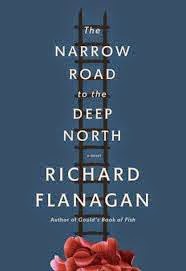
Dear Readers, I don't even know how to tell you about The Narrow Road to the Deep North by Richard Flanagan. I'm still blown away, three days after completing this 2014 Man Booker Prize Winner. I haven't heard much talk about this book, so I don't even know where to begin. It's harrowing to read about the construction of the Thai-Burma Railway, or Death Railway in 1942-1943.  Slave laborers, including Asians and Allied prisoners of war, were forced to build this railway in brutal conditions. More than 12,000 Allied prisoners died in the effort.  See the famous film Bridge Over the River Kwai (1957) for a slightly different view of this horrific chapter in history.  The Narrow Road is about a group of Australian POWs and the Australian surgeon Dorrigo Evans who was forced to care for the sick and dying of this band of slave laborers in the worst conditions possible.  

The novelist Richard Flanagan, a native Australian, has accomplished a feat comparable to the building of that 258-mile railway as he weaves a story of love and war and lost dreams. Flanagan's own father was a POW who survived the building of the Death Railway and actually died the day Flanagan finished the novel.  This tribute to his native Australians who survived this horrible chapter in history is astounding in its description of the human condition. He intersects the stories of the men on the railway and how the survivors'  lives turned out after their return to home and family with those of their captors, the seemingly evil Japanese officers, also during and after the railway construction. Many of the Japanese and Koreans slave drivers went through war crimes trials after WWII. Underlying the brutal scenes in the Asian jungle is the poignant love story of Dorrigo Evans and his uncle's wife. The title of the book comes from the title of a famous book by a 17th century Japanese haiku poet Basho, who said "every day is a journey and the journey itself home."

Like that quote, this book seems to follow a circular pattern with all the journeys becoming home. Dorrigo understands at the end …"the love story would go on forever and ever, world without end."  In one beautiful statement near the beginning of the book, Flanagan talks about the feeling of communion books bring. He said, "At such times, he had the sensation that there was only one book in the universe, and that all books were simply portals into this greater ongoing work - an inexhaustible, beautiful world that was not imaginary but the world as it truly was, a book without beginning or end."   Life is a circle of beauty and horror like the ancient haiku by Issa quoted in the book, 
In this world
we walk on the roof of hell
gazing at flowers.

The best books give us a glimpse into the meaning of life. This book is one of those.  The chair of the judges of the Man Booker Prize, 2014, A.C. Grayling said, "Some years very good books win the Man Booker Prize, but this year a masterpiece has won it."  Don't miss The Narrow Road to the Deep North.